
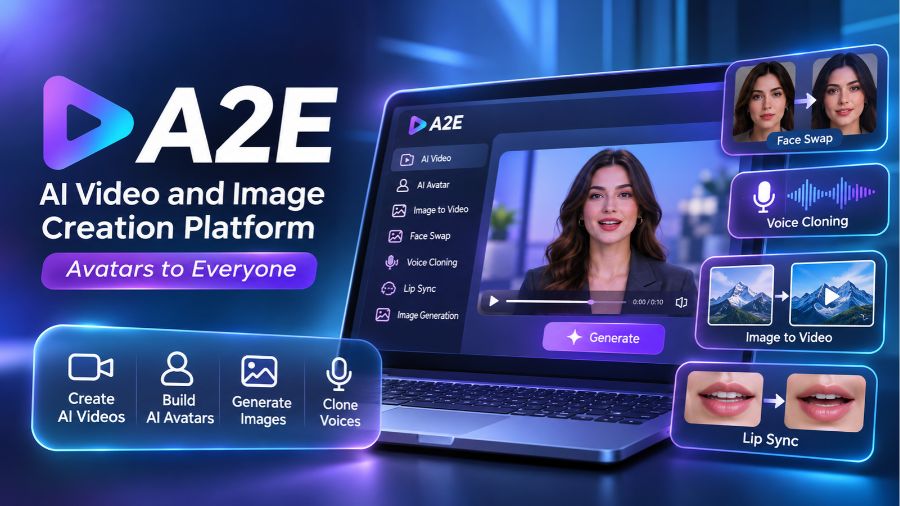
A2E is an AI-powered video and image creation platform designed to help creators, businesses, marketers, and developers produce digital content without relying entirely on traditional cameras, microphones, or production teams. Known for its AI avatars, face-swapping technology, voice cloning, lip synchronization, and image-to-video capabilities, A2E brings several creative tools together in one platform. Its approach focuses on making AI-generated visual content more accessible for professional projects, social media, marketing campaigns, online education, and digital communication. Understanding how A2E works, what features it offers, where it can be useful, and what limitations users should consider can help individuals and businesses decide whether this technology fits their creative needs.
What Is A2E?
A2E is an artificial intelligence content creation platform whose name stands for Avatars to Everyone. It aims to make AI avatar technology more accessible by providing tools for generating videos, creating digital presenters, modifying images, and producing voice-based content. Rather than requiring users to organize a complete video production setup, the platform brings different AI-powered capabilities into a single online environment. Its advertised services include text-to-image generation, image-to-video conversion, AI avatars, talking photographs, voice cloning, lip synchronization, face swapping, and clothing changes. These features make A2E relevant to content creators, online businesses, educators, advertisers, and developers interested in experimenting with automated media production.
How Does A2E Work?
A2E uses artificial intelligence models to process text instructions, uploaded images, audio recordings, and video files, depending on the selected tool. The general workflow begins when a user chooses a creative function, supplies the required input, and adjusts available settings before generating the result. For example, someone creating an animated portrait can upload a photograph, select an image-to-video model, describe the desired movement, and submit the request for processing. A talking-photo workflow may instead require a portrait and audio or text that will be converted into speech. Behind these interactions, different AI models handle image generation, visual modification, speech synthesis, facial movement, and video production. The platform also offers access to multiple third-party model families, allowing users to explore different generation approaches rather than depending on one model for every project.
Main Features of the A2E Platform
A2E combines several creative technologies that address different stages of digital content production. Its feature collection includes AI video generation, image editing, avatar creation, voice processing, and automated visual effects. The available tools and model selection can change as the platform develops, so users should check the current interface before planning a production workflow.
AI Video Generation
AI video generation is one of the platform’s central capabilities. Users can create moving visuals from written prompts, reference images, and supported source materials. This functionality can help transform a creative idea into a short promotional clip, an animated scene, or a social media video without recording every visual element manually. A2E lists several video-generation model options, including models from different AI developers. These models may differ in motion quality, prompt interpretation, generation duration, reference-image support, and output consistency. Selecting a suitable model is therefore important because a model that performs well for cinematic scenes may not necessarily be the best choice for product demonstrations or character-focused content.
Image-to-Video Conversion
Image-to-video technology allows users to animate an existing photograph, illustration, or product image. Instead of creating an entire scene from scratch, the user provides a visual reference and describes how it should move. This can be useful for turning a static product photograph into a short advertising clip, animating a character illustration, or adding subtle movement to a portrait. A2E promotes motion guidance and reference-based controls as part of its image-to-video offering. However, generated movement can sometimes introduce visual inconsistencies, particularly around hands, facial details, clothing, and complex backgrounds. Reviewing the final video and making adjustments is important when the result will be used in professional campaigns.
AI Avatars and Digital Presenters
AI avatars provide a way to create digital characters that can represent a person, presenter, or fictional identity in video content. A2E offers avatar-related tools that support the creation and animation of digital presenters using supported image and video inputs. Businesses may find this technology useful for product explanations, training materials, educational presentations, and multilingual communication. A digital presenter can also help creators produce recurring video formats without recording a new live performance for every update. Nevertheless, avatar quality depends on the input material, facial consistency, voice characteristics, and the selected generation model. Users should also make clear when a presentation features a synthetic person rather than a genuine recording of an individual.
AI Face Swap and Head Swap
Face swapping and head swapping are separate visual editing capabilities available through A2E. Face swap technology replaces a face in an image or video with another face, while head swap tools can modify a larger portion of the subject’s appearance. These functions may be used for authorized creative projects, fictional entertainment, visual experiments, and certain marketing concepts. They can also create misleading media when applied without permission or proper disclosure. Users should only upload images and videos they have the right to use, obtain consent from identifiable individuals, and avoid presenting manipulated footage as authentic evidence or genuine statements.
Voice Cloning and AI Speech
A2E includes voice-cloning capabilities that can generate synthetic speech resembling a supplied voice sample. Its platform advertises support for more than 50 languages and cross-language voice applications. This can help creators develop consistent narration, produce multilingual educational materials, and experiment with localized advertising. Voice generation may also reduce the need to record every version of a script separately. However, voice similarity and pronunciation can vary according to recording quality, language, accent, and the selected model. Voice cloning should only be performed with appropriate authorization, particularly when the recording belongs to another person or could be mistaken for an authentic statement.
Talking Photos and Lip Synchronization
Talking-photo technology gives a still portrait the appearance of speaking by generating facial movements that correspond to supplied audio or text-based speech. Lip synchronization is particularly important because poorly aligned mouth movements can make a digital presenter look unnatural. A2E highlights lip-sync quality as one of its areas of focus and describes its development of models for different facial structures and languages. These tools can support educational explainers, animated announcements, digital characters, and short promotional presentations. Results still require review because generated expressions, mouth movements, and facial details may not remain consistent throughout every frame.
AI Image Generation and Editing
The platform also provides AI image generation and editing tools that allow users to create or modify visual assets using written instructions. Text-to-image generation can turn a description into an illustration, marketing visual, or conceptual image, while image editing can help change selected elements in an existing picture. These capabilities may be useful for website graphics, product concepts, social media posts, and advertising experiments. A2E also provides access to different image model options, which can produce varying visual styles and editing results. As with other generative systems, users should check text accuracy, object proportions, image details, and commercial usage rights before publishing generated material.
Who Can Benefit from Using A2E?
A2E may appeal to several groups because its tools address different content-production requirements. Independent creators can experiment with AI-generated videos and animated images, while small businesses can explore product visuals and promotional presentations without arranging a traditional filming session for every concept. Marketing teams may use avatars and multilingual narration to prepare alternative versions of educational or advertising content. Teachers and online course developers can investigate talking presentations and synthetic narration for instructional materials. Developers can also explore the platform’s API offerings to connect supported media-generation functions with their own applications. However, the suitability of A2E depends on project requirements, available credits, model performance, licensing conditions, and the amount of editing required after generation.
A2E for Businesses and Digital Marketing
Businesses increasingly need visual material for websites, social media channels, online stores, advertising campaigns, and customer education. A2E provides tools that may help simplify some of these activities by combining image creation, video generation, voice production, and avatar technology. An online retailer, for example, could experiment with animated product images or synthetic presenters explaining product features. A digital marketing agency might explore multilingual narration for campaigns targeting audiences in different markets. Training departments could investigate avatar-led instructional videos for internal communication. These applications can make content experimentation more flexible, but AI-generated media should not automatically replace professional creative work. Brand consistency, factual accuracy, customer trust, and human review remain important when publishing business-related content.
Is A2E Free to Use?
A2E advertises free access to its platform and indicates that users can begin exploring certain tools without providing a credit card. However, free access should not be confused with unlimited use of every feature or AI model. Video generation and advanced image processing can require computing resources, and different tools may operate under separate credit requirements or subscription conditions. The platform also promotes API experimentation and usage-based billing options for developers. Since prices, promotional offers, credit allowances, and subscription conditions can change, users should examine the current pricing page before purchasing a plan or committing to a larger project. It is also sensible to test a small sample first to understand how quickly credits are consumed.
A2E API and Integration Capabilities
A2E is not limited to users who want to generate media through a browser interface. Its official developer materials describe API access that allows supported features to be incorporated into external applications and digital products. This may interest software developers building video-generation services, avatar applications, educational platforms, or automated marketing systems. An API-based workflow can connect a website or application to selected AI media functions without requiring every user to operate the A2E interface directly. Developers should review the current API documentation for authentication requirements, supported models, request formats, usage limits, pricing, and integration conditions. API availability does not necessarily mean every website feature is exposed through an identical endpoint, so technical planning should begin with the documented capabilities.
Advantages of Using A2E
One important advantage of A2E is the range of creative tools available within one platform. Users can explore image generation, video creation, avatar animation, voice cloning, and facial synchronization without immediately subscribing to several separate services. Its multiple model options also give creators opportunities to compare different generation approaches for particular projects. Another potential benefit is accessibility: people without professional filming equipment can experiment with digital presentations and visual storytelling. Developers may find the API offering useful when building media-related applications. For small teams, these capabilities can reduce some production requirements and make early creative experiments easier. The actual time and cost savings, however, depend on output quality, usage limits, editing needs, and the complexity of the intended project.
Limitations and Important Considerations
Despite its broad feature collection, A2E should not be viewed as a complete replacement for professional video production, image editing, or voice recording. Generative models can produce inconsistent results, misunderstand prompts, distort facial features, or create unrealistic movements. Some outputs may require several attempts before they meet professional standards, which can increase credit consumption and editing time. Users should also consider the privacy implications of uploading personal photographs, identity-related images, audio recordings, and confidential business material. Before using the platform, they should review its privacy policy, terms of service, data retention provisions, and commercial licensing conditions. Face swaps and voice cloning require particular care because unauthorized use can damage reputations, facilitate impersonation, and mislead audiences. Clear consent and appropriate disclosure are essential safeguards.
How A2E Compares With Traditional Content Creation
Traditional content production often involves cameras, lighting, microphones, actors, presenters, editors, and dedicated post-production workflows. A2E offers an alternative approach for certain tasks by using AI models to generate or modify digital media from supplied inputs. This can make early-stage experimentation faster and allow creators to test different concepts before arranging a full production. However, the two approaches serve different purposes. Traditional filming provides direct control over real performances, physical products, locations, and genuine interactions, while AI generation offers flexibility for synthetic scenes and automated modifications. Professional projects may benefit from combining both methods, using real footage where authenticity matters and AI-generated elements where they provide a practical creative advantage.
The Future of AI Video and Avatar Technology
AI video technology is developing through improvements in motion generation, character consistency, image understanding, speech synthesis, and multimodal processing. Platforms such as A2E are bringing different models and creative tools into more accessible environments, giving users opportunities to explore these developments without building their own generation systems. Future progress may make synthetic presenters more expressive, video editing more responsive to natural-language instructions, and multilingual production easier to manage. However, technical improvements will also increase the importance of media transparency, identity protection, copyright compliance, and responsible AI use. The long-term value of platforms in this category will depend not only on generation quality but also on reliability, pricing, privacy protections, and the practical needs of their users.
Conclusion
A2E is an AI-powered media creation platform that brings together video generation, image editing, digital avatars, voice cloning, face swapping, and lip-sync technology. Its combination of creative tools, multiple AI model options, and developer-focused integration capabilities makes it relevant to content creators, businesses, educators, and software developers exploring automated media production. At the same time, generated content requires quality checks, responsible use, consent, and careful attention to privacy and licensing. A2E can be a useful option for experimenting with modern AI video and image workflows, but choosing the right tool ultimately depends on the project’s creative goals, budget, and quality requirements.
FAQs
What does A2E stand for?
A2E stands for Avatars to Everyone, reflecting the platform’s goal of making AI-powered avatar creation and digital video production more accessible.
What is A2E used for?
A2E is used to generate AI videos, create digital avatars, animate photographs, clone authorized voices, edit images, and produce synchronized speech.
Does A2E offer free access?
Yes, A2E advertises free access to selected tools, although advanced features, generation credits, and usage conditions may require payment.
Can A2E create videos from photographs?
Yes, its image-to-video technology can transform supported photographs into animated videos using AI-generated movement and available creative controls.
Is A2E suitable for businesses?
A2E can support marketing, product presentations, educational videos, digital advertising, and multilingual content production, depending on project requirements.
Is A2E safe for creating AI videos?
A2E users should protect personal information, obtain consent before using someone’s likeness or voice, and review privacy and licensing conditions.
Also read: Ambient Weather Network Outdoor Wi-Fi Weather Camera