
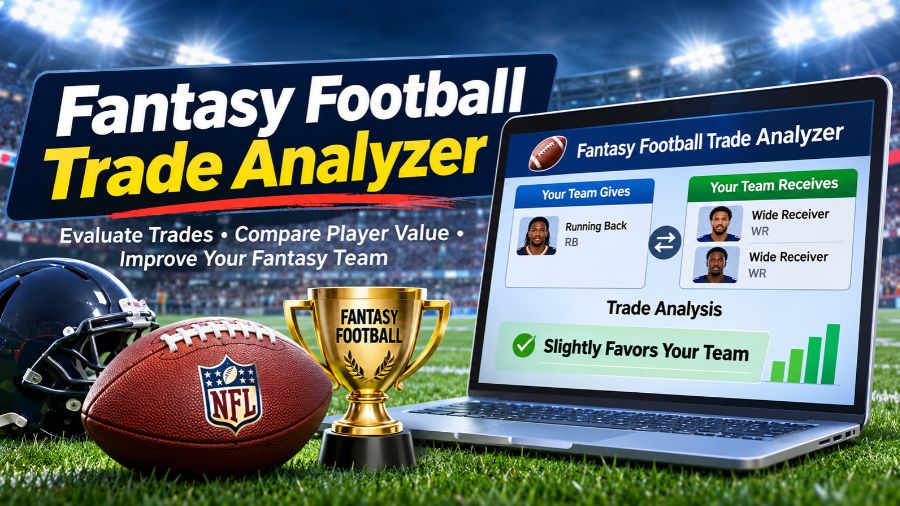
Fantasy Football Trade Analyzer tools help fantasy football managers evaluate player exchanges, compare projected performance, and make more informed decisions throughout the NFL season. Whether you play in a redraft, dynasty, standard-scoring, or points-per-reception (PPR) league, understanding player value is essential before accepting or rejecting a trade. These tools combine player rankings, statistical projections, scoring formats, and other relevant information to estimate which side of a proposed deal offers greater value. This guide explains how fantasy football trade analyzers work, their most useful features, their limitations, and how to use them effectively.
What Is a Fantasy Football Trade Analyzer?
A Fantasy Football Trade Analyzer is a digital tool designed to assess proposed player exchanges in fantasy NFL leagues. It compares the estimated value of players on both sides of a trade and helps managers understand whether an offer improves their team’s competitive position. Depending on the platform, an analyzer may use expert rankings, statistical projections, historical trade data, player availability, and league-specific scoring rules. Some tools focus on individual player values, while more advanced systems evaluate the complete roster to determine how an exchange affects starting positions, bench depth, and overall team strength. The main purpose is to provide a more objective perspective before managers commit to a deal.
How Does a Fantasy Football Trade Analyzer Work?
A trade analyzer generally works by collecting player information, applying a valuation model, and comparing the combined value of the players being exchanged. Users select the players they want to trade and the players they expect to receive. The system then calculates estimated values based on its available data and displays a comparison that may include projected fantasy points, rankings, trade grades, or team-strength assessments. More sophisticated platforms also account for roster construction, league size, scoring rules, and positional requirements. However, different websites use different calculation methods, meaning two analyzers can produce different results for the same proposed trade.
Player Value Assessment
Player valuation is the foundation of most trade analysis tools. A player’s estimated value may depend on recent performances, projected statistics, age, consistency, position, workload, and expected opportunities. For example, a running back receiving regular carries and targets may have a different trade value from a backup player who depends on injuries to earn playing time. Similarly, a wide receiver with consistent targets may offer a more dependable weekly contribution than someone whose production depends heavily on occasional long touchdowns. These factors help an analyzer estimate player value, although no model can predict every future performance accurately.
Comparing Both Sides of a Trade
Once the players are selected, the analyzer calculates the estimated value of each side. Imagine a manager offering one high-ranking running back in exchange for two wide receivers. A basic calculator adds the estimated values of the players and compares the totals. If one side receives a higher combined value, the system may identify that team as the apparent winner. However, a numerical advantage does not automatically make a trade beneficial. The manager must also consider whether the additional players can enter the starting lineup and whether the exchange solves an important weakness.
Using Statistical Projections
Statistical projections help trade tools estimate how players might perform during upcoming games. These projections can consider passing yards, rushing attempts, receiving targets, touchdowns, receptions, and other fantasy-relevant statistics. Rest-of-season projections are particularly useful when managers are evaluating trades during the regular season because they focus on expected production over the remaining schedule. Nevertheless, projections are estimates rather than guaranteed outcomes. Injuries, coaching decisions, changing offensive systems, weather, and unexpected changes in playing time can affect actual results.
Important Features of Fantasy Football Trade Analyzer Tools
Modern trade analyzers offer more than simple player comparisons. Their features vary by provider, but many platforms combine player rankings, trade calculations, roster evaluations, and league-specific information to provide a more complete picture of a proposed exchange. Understanding these capabilities helps managers choose a tool that matches their fantasy football format and decision-making needs.
PPR and Standard Scoring Support
Scoring format is one of the most important factors in fantasy football trade evaluation. In a standard non-PPR league, players do not receive additional points for receptions, whereas a full-PPR league awards one point per reception under the common ESPN standard format. Half-PPR leagues award half a point per catch. This difference can significantly influence the value of running backs, wide receivers, and tight ends. A receiver who catches many short passes may become more valuable in PPR than in standard scoring. Therefore, managers should select the correct scoring format whenever an analyzer provides that option.
Dynasty and Redraft Trade Analysis
Redraft and dynasty leagues require different approaches to player valuation. In a redraft league, managers generally focus on the current season because team rosters are rebuilt for the next fantasy season. Dynasty leagues allow managers to retain players across multiple seasons, making age, development potential, long-term opportunity, and future draft picks important considerations. A young player with developing potential may be more attractive in dynasty than an older player who offers stronger immediate production. Tools such as FantasyPros and FantasyCalc provide features designed to support different types of fantasy football trade decisions.
Trade Grades and Player Rankings
Some platforms convert their calculations into letter grades, numerical scores, or rankings to make comparisons easier to understand. A trade grade can offer a quick indication of how a deal looks according to the platform’s valuation system. Rankings also help managers compare players within their respective positions and identify differences between current-season and long-term value. However, a grade should be treated as guidance rather than a final verdict because it may not fully represent a manager’s roster requirements or personal strategy.
Roster and League Analysis
Advanced trade analyzers examine more than the players included in an offer. They may consider existing starters, bench depth, positional needs, league standings, and available replacement players. For example, trading away a running back might be reasonable for a team with several reliable alternatives at that position. The same transaction could create a major problem for a roster that has no dependable replacement. FantasyPros’ Trade Analyzer emphasizes whole-roster evaluation and the effect of trades on league power rankings, illustrating why team context can be more useful than comparing player values alone.
Popular Fantasy Football Trade Analyzer Tools
Several established fantasy sports platforms provide tools for evaluating player exchanges, although their features, pricing, and valuation methods differ. Fantasy managers should compare their capabilities rather than assuming that every platform calculates trade values in the same way.
FantasyPros Trade Analyzer
FantasyPros offers a Fantasy Football Trade Analyzer through its MyPlaybook platform. Its approach considers the overall roster, league settings, expert rankings, and the potential short-term and rest-of-season impact of a proposed exchange. It also supports dynasty trade evaluation, including deals involving future draft picks. One useful distinction is its focus on how a trade affects the complete team rather than simply calculating the combined value of the players involved. Access to specific features may depend on the platform’s subscription arrangements.
FantasyCalc Trade Calculator
FantasyCalc provides fantasy football trade calculations, player rankings, league analysis, and trade value information. Its published methodology explains that player values are derived from real fantasy football trade data and an optimization process. It also describes adjustments for league settings, including PPR scoring, Superflex formats, and league size. This makes it particularly relevant to managers interested in dynasty valuations and market-based player comparisons. Its approach differs from systems that rely primarily on expert rankings or projected statistical performance.
RotoWire Fantasy Football Tools
RotoWire is another established fantasy sports information provider offering player analysis, projections, news, and fantasy football resources. These resources can help managers research the factors behind a potential trade, including injuries, player roles, and expected performance. When using any platform’s trade-related tools, managers should check which features are included in its current offering rather than assuming every resource is available without a subscription.
FantasySP Trade Analysis
FantasySP provides fantasy sports resources that help managers evaluate player performance and roster decisions. Its analysis tools can complement a trade calculator by offering additional player information and fantasy recommendations. Managers can use these types of resources to investigate whether a proposed trade addresses a genuine roster weakness instead of relying exclusively on a numerical comparison.
How to Evaluate a Fantasy Football Trade Correctly
Using a calculator is only one part of making a successful trade decision. Managers should combine its estimated values with an understanding of their roster, competition, scoring system, and remaining schedule. A trade that looks attractive on paper might create a positional shortage, while an apparently uneven exchange could improve a team’s chances of winning weekly matchups.
Understand Your Team’s Weakest Position
Before proposing a trade, identify which positions need improvement. A team with several dependable wide receivers but limited running back depth may benefit from exchanging a receiver for a starting running back. Conversely, a roster with strong running backs and inconsistent wide receivers may need a different strategy. The purpose of trading should be to improve the team’s overall competitive position, not simply collect players with high individual rankings.
Evaluate Remaining Season Performance
Current player rankings do not always reflect future usefulness. Managers should consider the expected production over the remaining season rather than relying entirely on past points. A player who started strongly may experience reduced opportunities, while another could become more valuable after receiving an expanded role. Rest-of-season projections, recent usage, team offensive performance, and upcoming matchups can provide additional context. It is also important to recognize that schedules and projected opportunities do not guarantee future fantasy results.
Consider Injuries and Playing Time
Injury status can significantly affect trade value. A player recovering from an injury may have considerable long-term potential but limited immediate availability. Managers should investigate official injury reports, practice participation, expected workload, and relevant team updates before accepting an offer. They should also consider competition within the player’s position group. A talented player who shares opportunities with several teammates may produce fewer fantasy points than someone with a secure starting role.
Account for Bye Weeks and Roster Depth
Bye weeks can temporarily reduce the number of available starters, making depth especially important during the regular season. Trading away multiple players for one star can leave a manager struggling to fill starting positions when several players have the same bye week. Bench depth also provides protection against injuries and unexpected changes in team roles. An effective trade should strengthen the starting lineup without creating unnecessary weaknesses elsewhere.
Examine the Other Team’s Needs
Successful fantasy trades often require both managers to see a practical benefit. Understanding another team’s roster can help identify players that manager may be willing to exchange. For instance, a team with several strong quarterbacks in a Superflex league might have different priorities from a team lacking a dependable starter. Looking at both rosters can help create realistic offers instead of proposing deals based only on personal preferences.
Benefits of Using a Fantasy Football Trade Analyzer
A trade analyzer makes player comparisons easier by presenting information in a structured format. Instead of manually calculating projected points or comparing several rankings, managers can use a single interface to estimate the relative value of different players. It can also help identify overlooked opportunities, highlight potential roster weaknesses, and provide an additional perspective when negotiations become difficult. Dynasty managers may benefit from long-term player valuations, while redraft managers can focus on immediate production and the remaining schedule. Most importantly, these tools encourage managers to examine a trade more carefully instead of accepting an offer based entirely on reputation or recent performances.
Limitations and Common Mistakes to Avoid
Although trade calculators are useful, their recommendations should not be treated as guarantees. Every valuation model depends on the quality, timing, and assumptions of its underlying information. Different platforms may use expert rankings, historical trade transactions, statistical projections, or combinations of these methods. As a result, the same players can receive different values across websites. Models may also struggle to account for sudden injuries, coaching changes, unexpected breakouts, and changes in team strategy. Another common mistake is ignoring roster context and accepting a trade simply because the calculator gives one side a higher score. Managers should also avoid treating short-term statistical trends as proof of future performance. The best approach is to use an analyzer alongside current player news, league rules, and independent judgment.
Conclusion
A Fantasy Football Trade Analyzer is a valuable resource for managers who want to make smarter player exchanges and build more competitive NFL fantasy teams. By combining player valuations, statistical projections, scoring formats, injury information, and roster analysis, these tools provide a clearer understanding of potential trade outcomes. Platforms such as FantasyPros and FantasyCalc offer different approaches to evaluating player value, making it useful to compare their recommendations before accepting an offer. However, no calculator can guarantee a successful trade or predict every player’s future performance. The strongest decisions come from combining analytical tools with knowledge of league settings, positional requirements, player availability, and long-term team strategy.
FAQs
What is a Fantasy Football Trade Analyzer?
A Fantasy Football Trade Analyzer evaluates proposed player exchanges by comparing estimated player values, projected performance, scoring settings, and potential roster improvements.
Are Fantasy Football Trade Analyzers free to use?
Some platforms provide free trade calculators, while advanced features such as personalized roster analysis, premium projections, and expert recommendations may require subscriptions.
What is the best Fantasy Football Trade Analyzer?
FantasyPros and FantasyCalc are popular options, offering different valuation methods, including expert rankings, roster analysis, historical trade data, and dynasty evaluations.
How accurate are fantasy football trade calculators?
Their accuracy depends on data quality, valuation methods, projections, and league settings. Results are estimates, not guarantees of future player performance.
Can I use a trade analyzer for dynasty leagues?
Yes, several platforms support dynasty leagues by considering player age, long-term potential, future draft picks, and expected value across multiple seasons.
Does PPR scoring affect fantasy football trade values?
Yes, PPR scoring awards additional points for receptions, increasing the relative value of players who regularly catch passes compared with standard-scoring leagues.
Also read: Longboard Skateboard