
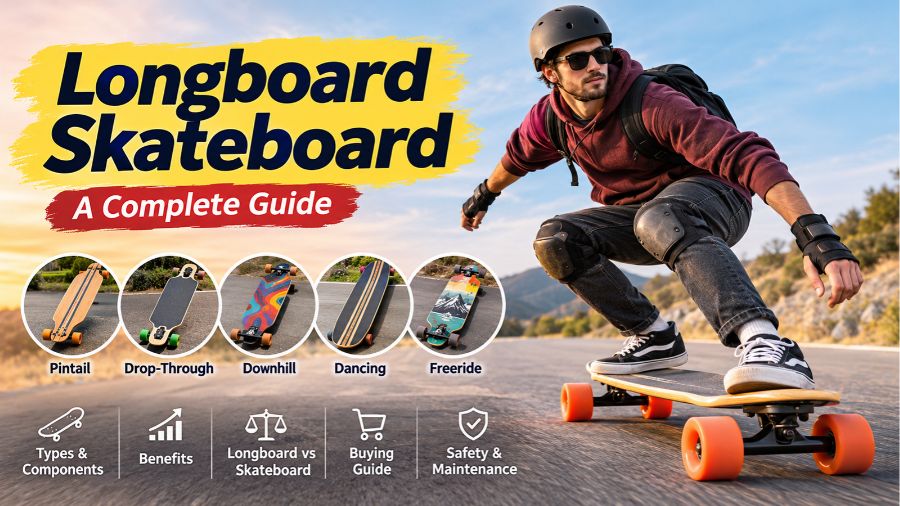
Longboard Skateboard is a popular type of skateboard designed for smooth cruising, comfortable transportation, carving, downhill riding, and recreational activities. Unlike traditional skateboards, longboards feature longer decks, larger wheels, and different truck configurations that influence stability, turning, and overall riding performance. They appeal to beginners, experienced skateboarders, commuters, and outdoor enthusiasts who want a different riding experience. Understanding the different longboard styles, components, advantages, limitations, and safety requirements can help riders choose the right equipment and develop their skills confidently.
What Is a Longboard Skateboard?
A longboard skateboard is a wheeled riding board that generally has a longer deck and a different construction from conventional street skateboards. Most longboards are designed to provide stability, smooth movement, and comfortable handling across suitable paved surfaces. Their decks are commonly made from laminated maple, bamboo, fibreglass, or combinations of these materials, depending on the manufacturer’s design. Longboard dimensions vary considerably, with many recreational models measuring approximately 33 to 48 inches, while specialised dancing and downhill boards can be longer or shorter. Larger polyurethane wheels help the board roll over small cracks and surface imperfections more comfortably. Longboards are particularly popular for cruising, carving, commuting, freeride skating, and downhill disciplines. Although they share the basic construction of traditional skateboards, their shapes and components are adapted to different riding requirements.
History and Development of Longboard Skateboards
Longboard skateboarding developed from the wider skateboarding culture that emerged in the United States during the 1950s. Early skateboarders wanted an activity that could recreate some of the movement and feeling of surfing when ocean conditions were unsuitable. This influence encouraged experimentation with longer wooden boards, different wheel designs, and alternative truck configurations. As skateboarding developed, manufacturers introduced equipment that supported different riding styles, including street skating, cruising, racing, and downhill riding. Longboards gradually became a distinct category within the sport because their dimensions and construction offered advantages for travelling across longer distances and maintaining control during particular riding activities. Modern longboards now incorporate improved materials, specialised wheel compounds, precision trucks, and different deck profiles. These developments have created a diverse equipment market serving casual riders as well as experienced athletes.
Main Components of a Longboard Skateboard
Understanding the construction of a longboard helps buyers recognise how individual components influence performance, comfort, and handling. Although manufacturers offer many designs, most complete longboards contain a deck, grip tape, trucks, wheels, bearings, and mounting hardware. Each component has a specific purpose, and compatibility between these parts is important when assembling or upgrading a board.
Longboard Deck
The deck is the main platform on which the rider stands. Its length, width, shape, concave profile, and flexibility influence how the board feels during movement. Some decks are relatively flat, while others include curved edges or raised sections that provide additional foot control. Maple is commonly used because laminated wood can provide strength and a familiar riding feel. Bamboo and composite materials are also used to create different combinations of flexibility, durability, and weight. A beginner should consider a deck that provides sufficient standing space and suits their intended riding style rather than automatically choosing the longest available model.
Trucks and Turning Mechanism
Trucks are the metal assemblies attached underneath the deck that connect the wheels to the board. They play an important role in steering, stability, and responsiveness. Reverse kingpin trucks are commonly associated with longboards because their geometry supports the turning characteristics required for cruising and carving. Traditional kingpin trucks are also used on certain shorter cruisers and specialised designs. Bushings inside the trucks influence how easily the board turns when the rider shifts their weight. Truck width should be compatible with the deck, while adjustment should reflect the rider’s experience and preferred handling characteristics.
Wheels and Bearings
Longboard wheels are generally larger than standard street skateboard wheels and are commonly made from polyurethane. Their diameter, hardness, width, and contact patch affect acceleration, grip, comfort, and sliding behaviour. Many cruising setups use wheels approximately 65 to 75 millimetres in diameter, although specialised equipment can differ considerably. Softer wheels, often around 78A to 83A on the commonly used durometer scale, can absorb vibrations and provide grip on imperfect surfaces. Bearings fit inside the wheels and allow them to rotate around the truck axles. Their condition, cleanliness, lubrication, and proper installation matter more to everyday performance than simply choosing the highest advertised ABEC rating.
Different Types of Longboard Skateboards
Longboards are available in several designs because riders have different expectations from their equipment. A board designed for comfortable transportation may not be suitable for advanced downhill riding, while a specialised dancing deck may feel unnecessarily large for someone who wants a compact commuting option. Understanding these differences makes selecting a suitable model easier.
Pintail Longboard
A pintail longboard features a distinctive pointed shape near one or both ends of its deck, resembling the outline of a traditional surfboard. It is commonly associated with recreational cruising and carving because its shape provides a comfortable platform for relaxed riding. Many pintail boards use larger, softer wheels that support smooth movement on suitable paved surfaces. Their appearance and straightforward design make them attractive to casual riders and people interested in learning basic longboarding techniques. However, not every pintail model is equally suitable for advanced tricks or technical downhill activities, so buyers should consider the complete setup rather than relying on deck shape alone.
Drop-Through Longboard
A drop-through longboard has trucks mounted through openings in the deck rather than attached entirely underneath it. This construction lowers the standing platform compared with many traditional top-mounted designs. A lower deck can make pushing more comfortable because the rider does not need to bend as deeply to reach the ground. It can also provide a different sense of stability during cruising and freeride activities. Drop-through boards are available in different lengths and shapes, making them suitable for several riding preferences. However, their actual handling depends on truck geometry, deck construction, wheel selection, and overall setup.
Drop-Down Longboard
A drop-down longboard features a deck that curves downward between the truck mounting areas, creating a lowered standing platform. This design brings the rider closer to the ground and can make pushing and foot braking more accessible. Some models are designed for commuting and long-distance cruising, while others support freeride techniques. The lowered platform may provide a comfortable riding position, particularly for people who prefer not to stand high above the wheels. Nevertheless, riders should evaluate the deck’s flex, construction, weight capacity, and wheel clearance before selecting a specific model.
Downhill Longboard
Downhill longboards are designed for riders who participate in specialised downhill skateboarding. These boards commonly prioritise stability, predictable handling, and controlled performance at speed. Their decks may feature stiff construction, specific concave profiles, and carefully selected truck and wheel combinations. Downhill riding is substantially more demanding than ordinary recreational cruising because speed, road conditions, braking technique, and equipment setup all influence safety. It is not an appropriate starting activity for inexperienced skateboarders. Riders should develop fundamental skills and seek suitable instruction before attempting advanced downhill routes.
Dancing Longboard
A dancing longboard generally features an extended deck that provides room for footwork, walking movements, spins, and coordinated dance-style tricks. Its larger standing surface allows riders to move their feet across different sections of the board while maintaining balance. Some dancing decks also feature specialised flex characteristics and shapes that support particular movements. This discipline combines elements of skateboarding, balance, rhythm, and creative expression. Because these boards are often longer than ordinary cruising models, their size and weight may make them less convenient for everyday transportation.
Freeride Longboard
Freeride longboards are designed for technical riding that can include controlled slides, carving, and other advanced manoeuvres. They often use specialised wheel shapes and deck profiles that support the rider’s preferred techniques. Some freeride setups feature relatively stiff decks, while others incorporate different flex characteristics depending on the intended discipline. Learning to slide requires practice, suitable protective equipment, and an understanding of traction and speed control. Freeride boards can be versatile, but their specialised characteristics may not be necessary for someone who only wants a comfortable board for casual cruising.
Benefits of Using a Longboard Skateboard
A longboard offers several practical and recreational benefits when matched with the right rider and environment. Its larger wheels can make movement over minor pavement imperfections more comfortable than smaller, harder street skateboard wheels. Many longboard designs also provide a generous standing platform, which some beginners find easier to manage when learning basic balance and pushing techniques. Cruising and carving can provide an enjoyable outdoor activity while encouraging coordination, physical movement, and balance. Longboards may also serve as an alternative for short-distance transportation on suitable routes. However, their benefits depend on road quality, rider ability, equipment condition, and local restrictions. They are not automatically safer or more comfortable than every other form of wheeled transportation.
Longboard Skateboard vs Traditional Skateboard
The main difference between a longboard and a traditional skateboard is their intended riding style and overall construction. Traditional skateboards generally have shorter decks, smaller wheels, and shapes designed to support street tricks, skatepark activities, and technical manoeuvres. Longboards usually feature longer platforms, larger wheels, and truck configurations suited to cruising, carving, and other specialised disciplines. The longer wheelbase of many longboards can contribute to stability, although actual handling varies between models. Traditional skateboards are often easier to carry and more practical for performing tricks that require a lightweight, responsive deck. Longboards can be more comfortable over rougher paved surfaces, but their larger dimensions can make storage and transportation less convenient. Neither design is universally better because the appropriate choice depends on what the rider wants to accomplish.
How to Choose the Right Longboard Skateboard
Choosing a longboard requires more consideration than simply selecting an attractive design. Buyers should first identify whether they intend to cruise, commute, practise dancing, learn freeride techniques, or participate in downhill skating. The deck should provide suitable standing space and support the rider’s weight according to the manufacturer’s specifications. Wheel diameter and hardness should match the expected riding surface, while truck width and geometry must remain compatible with the deck. Beginners often benefit from a complete cruising setup because its components are already selected to work together. It is also sensible to inspect the board’s construction, grip tape, bearings, mounting hardware, and replacement-part availability. A more expensive board is not automatically the right choice, particularly when its design is intended for an activity the buyer does not plan to pursue.
Longboard Skateboarding Safety and Essential Equipment
Safety should be a priority whenever someone rides a longboard, regardless of age or experience. A properly fitted helmet designed for skateboarding can help reduce the risk of serious head injuries, while wrist guards, knee pads, and elbow pads provide additional protection during falls. Closed-toe footwear with suitable grip helps riders maintain contact with the deck. Beginners should practise on smooth, dry, flat surfaces away from vehicles, pedestrians, and other obstacles. Learning how to push, turn, slow down, and stop should come before attempting more demanding manoeuvres. Riders should inspect their wheels, bearings, trucks, deck, and mounting hardware before each session. Downhill riding and high-speed activities require substantially more experience and protective preparation. Local road regulations and restrictions should also be checked before using a longboard in public spaces.
Common Challenges and Limitations of Longboarding
Although longboarding can be enjoyable, it has limitations that potential buyers should understand. Rough roads, loose gravel, wet pavement, and uneven surfaces can affect traction and control. Larger boards may be difficult to carry through crowded places or store in small spaces. Some specialised models also require more maintenance knowledge and replacement components than a basic recreational setup. Long-distance commuting may become uncomfortable when routes contain steep inclines, frequent stops, or unsuitable pavement. Another important challenge is learning to control speed, particularly when riding downhill. Beginners sometimes underestimate the importance of braking and turning techniques, which can increase accident risks. Longboards are therefore best treated as recreational or transportation equipment that requires practice, appropriate surroundings, and regular inspection.
Longboard Skateboard Maintenance and Care
Regular maintenance helps preserve a longboard’s performance and identifies problems before they become more serious. The deck should be checked for cracks, delamination, unusual flex, and damage around the truck mounting areas. Wheels should be examined for uneven wear, cracks, and embedded debris, while trucks should be inspected for loose hardware and worn bushings. Bearings need occasional cleaning and appropriate lubrication, particularly after exposure to dust or moisture. Riders should avoid storing their boards in excessively wet environments because moisture can damage wooden decks and contribute to bearing corrosion. Any damaged component should be replaced with a compatible part before the next ride. A simple inspection routine can help extend equipment life and support more predictable handling.
Conclusion
A longboard skateboard offers a versatile way to enjoy cruising, carving, recreational skating, and specialised disciplines such as dancing and downhill riding. Its longer deck, larger wheels, and varied truck configurations create riding characteristics that differ from those of traditional skateboards. Choosing the right model depends on individual experience, intended activities, road conditions, and equipment compatibility. Understanding deck construction, wheel hardness, truck geometry, maintenance, and protective equipment helps riders make more informed decisions. Whether someone wants a comfortable cruising board or a specialised setup for advanced techniques, the most important consideration is selecting equipment that matches their abilities and using it responsibly.
FAQs
1. Is a longboard skateboard good for beginners?
Yes, many cruising longboards offer a stable platform and comfortable wheels, making them suitable for beginners learning balance, pushing, turning, and stopping.
2. What is the ideal longboard skateboard size?
There is no universal ideal size. Many recreational longboards measure approximately 33 to 48 inches, depending on riding style and personal preference.
3. Can you perform tricks on a longboard skateboard?
Yes, longboards support dancing, freestyle movements, sliding, and certain technical tricks, although specialised boards are designed for different manoeuvres.
4. Are longboard skateboards faster than regular skateboards?
Some longboards are designed for higher speeds, particularly downhill models, but actual speed depends on equipment, terrain, rider ability, and conditions.
5. What wheels are best for longboard skateboards?
Softer polyurethane wheels around 78A to 83A are commonly preferred for cruising because they provide grip and absorb vibrations on imperfect pavement.
6. How often should a longboard skateboard be maintained?
Inspect your board before every ride and clean bearings when needed. Check wheels, trucks, deck condition, and hardware regularly for wear or damage.
Also read: Alvaro Alcaraz Garfia