
Conversion nm ft lbs is a useful skill for anyone working with cars, motorcycles, machinery, or torque tools. If you have ever checked a vehicle’s tightening specifications or used a torque wrench, you have probably come across these two measurements. Newton-meters (Nm) and foot-pounds (ft-lbs) describe torque, which is the rotational force applied to an object. Although both units measure the same physical quantity, they use different measurement systems. Understanding how to convert between them makes it easier to follow technical instructions, work with international specifications, and tighten components accurately. Whether you are a professional mechanic or a DIY enthusiast, learning this simple conversion can help you avoid mistakes and work with greater confidence.
What Does Nm Mean in Torque Measurement?
Newton-meter, written as Nm or N·m, is the standard metric unit used to measure torque. One Newton-meter represents the torque produced when a force of one Newton acts perpendicular to a lever arm one meter long. In practical terms, imagine using a long wrench to tighten a bolt. The amount of rotational force you apply depends on how hard you push and how far your hand is from the bolt’s center. Newton-meters express the combined effect of these two factors. This unit is widely used in automotive engineering, industrial machinery, bicycle maintenance, and mechanical equipment. When a manufacturer specifies a tightening torque of 80 Nm, it means the fastener should be tightened to that particular torque value using an appropriate tool.
What Does Ft-Lbs Mean?
Foot-pounds, commonly abbreviated as ft-lbs or lb-ft when discussing torque, are used primarily in the United States and other settings that rely on customary measurement units. A foot-pound of torque describes the rotational effect of a force of one pound-force applied perpendicular to a lever arm one foot long. For example, if you apply a force of 10 pounds at a point one foot from a bolt’s center, you produce 10 foot-pounds of torque under the appropriate conditions. This unit appears frequently in American vehicle repair manuals, engine specifications, power tool documentation, and workshop instructions. Although the notation can vary, ft-lbs and lb-ft commonly represent the same torque unit. It is important to distinguish torque from energy, even though foot-pound is also used as a unit of work or energy in other contexts.
How to Convert Nm to Ft-Lbs
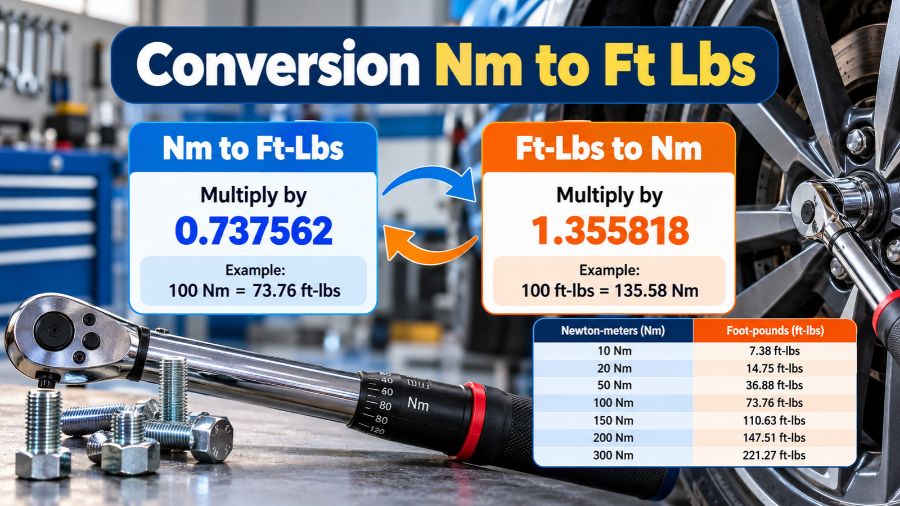
Converting Newton-meters to foot-pounds is straightforward once you know the correct multiplication factor. To convert Nm into ft-lbs, multiply the Newton-meter value by 0.737562. For most workshop tasks, using 0.7376 provides sufficient precision. For example, if a bolt requires 100 Nm of torque, multiply 100 by 0.737562 to obtain approximately 73.76 ft-lbs. Similarly, a specification of 50 Nm equals approximately 36.88 ft-lbs. This calculation is particularly useful when a repair manual lists metric measurements but your torque wrench displays foot-pounds. You do not need to perform a complicated calculation every time; keeping the conversion factor handy or using a reliable conversion calculator can make the process faster and reduce the risk of reading the wrong setting.
How to Convert Ft-Lbs to Nm
The reverse calculation is just as simple. To convert foot-pounds into Newton-meters, multiply the ft-lbs value by 1.355818. This factor is the reciprocal relationship of the conversion between the two units. For instance, a torque specification of 60 ft-lbs is approximately 81.35 Nm. If a vehicle manual specifies 100 ft-lbs, the equivalent value is approximately 135.58 Nm. This conversion is especially helpful when using metric torque tools to service equipment designed around American specifications. Always check which unit appears on your tool before adjusting it. Confusing the two measurements can lead to significant tightening errors, particularly when working on engine components, suspension systems, or other parts that require carefully controlled torque.
Nm to Ft-Lbs Conversion Chart
A conversion chart provides a quick reference when you do not want to calculate every value manually. Common torque settings include 10 Nm, 20 Nm, 50 Nm, 100 Nm, and 200 Nm, so knowing their approximate foot-pound equivalents can save time in a workshop. Ten Nm equals 7.38 ft-lbs, 20 Nm equals 14.75 ft-lbs, 50 Nm equals 36.88 ft-lbs, 100 Nm equals 73.76 ft-lbs, and 200 Nm equals 147.51 ft-lbs. Higher values follow the same mathematical relationship. For example, 300 Nm is approximately 221.27 ft-lbs. These figures are useful for quick comparisons, but they should not replace the exact specification provided by the equipment manufacturer. When a repair requires a particular torque value, use the most precise conversion appropriate for your tool and application.
Why Torque Conversion Matters in Automotive Repair
Torque conversion is particularly important when maintaining cars and motorcycles because manufacturers publish specifications using different measurement systems. A European vehicle might list wheel bolt torque in Newton-meters, while an American repair guide may provide foot-pounds. If your available torque wrench uses a different unit, you need to convert the specification before beginning work. Correct torque helps fasteners maintain the intended clamping force without being excessively tightened. Under-tightening may allow components to loosen, while over-tightening can stretch bolts, damage threads, distort parts, or cause fastener failure. These problems can affect wheel assemblies, engine components, brake systems, and suspension parts. Understanding the conversion process helps you follow the original specification instead of estimating how tight a bolt should feel.
Using a Torque Wrench After Conversion
A torque wrench allows you to apply a controlled amount of rotational force when tightening fasteners. Before using one, identify the unit displayed on its scale or digital screen. Some tools measure torque in Nm, while others use ft-lbs or offer both options. Convert the manufacturer’s specified value only when necessary, then set the wrench to the correct equivalent measurement. For example, if the required torque is 80 Nm and your wrench uses ft-lbs, the equivalent setting is approximately 59.01 ft-lbs. Check that the result falls within the tool’s operating range and accuracy limits. Follow the wrench manufacturer’s instructions for setting, holding, and using the tool. For critical fasteners, avoid substituting an ordinary wrench or relying on hand pressure alone, because neither provides the same level of measurement control.
Common Mistakes When Converting Nm and Ft-Lbs
One frequent mistake is multiplying by the wrong conversion factor. Remember that converting Nm to ft-lbs requires multiplying by approximately 0.737562, while converting ft-lbs to Nm requires multiplying by approximately 1.355818. Reversing these factors produces an incorrect result. Another common error is confusing torque with power. Newton-meters and foot-pounds measure torque, whereas horsepower and kilowatts measure power. They describe related but different physical quantities. Rounding too aggressively can also create problems when precision matters. Although rounding 73.76 ft-lbs to 74 ft-lbs is convenient for general reference, it may not be appropriate for every application. Finally, never assume that a fastener should be tightened to a particular value simply because a similar component uses that setting. Always confirm the correct specification for the exact model and component.
Can You Convert Nm to Ft-Lbs Without a Calculator?
Yes, you can estimate common torque conversions without a calculator if you remember a few reference values. One practical approach is to remember that 100 Nm is approximately 73.76 ft-lbs and 50 Nm is approximately 36.88 ft-lbs. Because the relationship is linear, you can estimate other values proportionally. For example, 150 Nm is one and a half times 100 Nm, giving approximately 110.63 ft-lbs. For a quick mental estimate, multiplying Nm by 0.74 will usually produce a reasonably close result. However, mental calculations are best suited to general understanding rather than precision work. When tightening critical fasteners or servicing safety-related components, use a calculator, conversion table, or properly configured digital torque wrench to verify the exact setting.
Understanding Torque Accuracy and Precision
Accurate torque measurement involves more than converting one unit into another. The condition of the fastener, thread cleanliness, lubrication, washer type, and tightening procedure can all affect the resulting clamping force. Two fasteners tightened to the same torque may not develop identical clamping forces if their thread conditions differ. This is one reason manufacturers specify whether threads should be dry, lubricated, or treated with a particular compound. Torque wrench accuracy also matters. A tool that is damaged, improperly maintained, or used outside its rated range may not deliver the expected result. For important mechanical work, follow the manufacturer’s complete tightening procedure, including any specified tightening sequence, staged torque settings, or angle-tightening requirements. Correct conversion is an essential part of the process, but it does not replace proper tools and procedures.
Conclusion
Conversion nm ft lbs is an essential skill for anyone who works with vehicles, mechanical equipment, or torque tools. Newton-meters and foot-pounds measure the same physical quantity, but they belong to different measurement systems. To convert Nm to ft-lbs, multiply by 0.737562; to convert ft-lbs to Nm, multiply by 1.355818. Keeping these formulas and a few common conversion values in mind makes it easier to understand repair manuals, configure torque wrenches, and follow technical specifications. However, accuracy should always come first when tightening important fasteners. Verify the original manufacturer’s requirements, use a suitable torque wrench, and pay attention to the prescribed tightening procedure. With a clear understanding of torque conversion, you can work more confidently, avoid common measurement mistakes, and achieve more consistent results in your mechanical projects.
FAQs
1. How do you convert Nm to ft-lbs?
To convert Newton-meters (Nm) to foot-pounds (ft-lbs), multiply the Nm value by 0.737562. For example, 100 Nm is approximately 73.76 ft-lbs.
2. How many ft-lbs is 100 Nm?
100 Nm equals approximately 73.76 ft-lbs. This conversion is commonly used when checking vehicle torque specifications or setting a torque wrench.
3. How do you convert ft-lbs to Nm?
Multiply the ft-lbs value by 1.355818 to convert it into Newton-meters. For example, 100 ft-lbs is approximately 135.58 Nm.
4. Are Nm and ft-lbs the same?
Nm and ft-lbs measure the same physical quantity: torque. However, Newton-meters belong to the metric system, while foot-pounds are commonly used in the US customary measurement system.
5. Why is Nm to ft-lbs conversion important for cars?
This conversion helps drivers and mechanics understand torque specifications in vehicle repair manuals and use torque wrenches with different measurement units.
Also read: Homecz